
IN THIS SERIES, I showcase armies used by your humble Jungle Guide. By detailing how the army was collected, how the background and color schemes were developed, and how the army is used on the battlefield, I hope to inspire those interested in collecting similar armies.
If Inquisitor Varman Kumar was tired after the 26 continuous hours he had spent working in the interrogation chamber, he showed no sign of it when he stepped out into the stone hallway. As the plasteel door slid shut behind Kumar, Wolf Priest Horsa Drachenbane stepped forward from the alcove where he had been waiting.
“What have you learned?” Horsa asked.
“I’m glad you asked me to examine and investigate your captive before you began your expedition,” Inquisitor Kumar said. He nodded to a Servitor, who brought a bowl of water and towels. Kumar began to wash from his hands the grey ooze that was the alien’s blood. “He—if it properly can be called he—is very interesting.”
“Did he tell you anything about the Wolf King’s ring?” Horsa demanded.
“He doesn’t know anything about it,” Kumar replied. Horsa was visibly disappointed. “However, I learned—at least, I think I learned—a great deal that might be useful to you and your men.”
“How so? Aren’t the Dvergar just part of the Leagues of Votann?”
“Not at all. Though they resemble them, they have almost nothing in common with the Kin. First off, he—and all other members of the Dvergar race—communicate by telepathy. They don’t have a spoken language.”
“But we’ve intercepted their transmissions,” Horsa protested. “We have hundreds of hours of vox recordings—”
Kumar shook his head. “Have you and your fellow Wolf Priests deciphered them yet?”
“No, but we’re getting close to figuring out their langua—”
“They don’t actually speak. Any vocalizations you’ve ever heard are gibberish: play-acting performed solely to mislead and confuse you—and waste your time.Your men should ignore anything they hear the Dvergar say or shout on the battlefield: it’s all distraction or intimidation.”
“How did you determ—”
“I’m an Inquisitor: my task is to find out answers that people—and Xenos—don’t want revealed. And it helps to have some telepathic ability of my own,” Kumar admitted. He finished washing his hands and dismissed the Servitor.
They started down the hall. “What else?” Horsa asked.
“What appears to be facial hair on them—”
“Their beards,” Horsa said, nodding.
“—is not actually that. I suspect so because when I cut some off him, our dear little friend was in quite a lot of pain. At least, I think he was. He—and his kind—might be very good at pretending.”
“The beard—”
“A mass of organic filaments, I believe,” Inquisitor Kumar replied, “thousands of them, each capable of independent motion. When I began exerting some substantial force on him, his ‘beard’ lashed out in all directions, either as an expression of pain or in an attempt to stop me—or both. Each tendril has some prehensile ability, but they aren’t very dexterous or strong—although they are harder to sever than human hair. They also maintain their ability to move for quite a while after I cut them off our subject. And would you like to learn something really interesting?”
“Go on,” Horsa replied.
“Even several hours after I had removed some of these ‘hairs’ from our dear little friend, he was seemingly able to feel it when I cut, burned, or otherwise mistreated one or more of those filaments.”
“Are you sure he wasn’t pretending?”
“To confirm my hypothesis, I conducted some of my dissections and examinations behind a curtain. His psychic screams were very powerful.”
“What are these…‘hairs’ for? What do the Dvergar do with them?”
“Obviously, they carry nerves, but what their actual function is, I don’t know. Perhaps they’re part of their sensory system, like whiskers on a cat.”
“A cat?”
“A Terran carnivore used for rodent control. Never mind. I’m hungry. Is this the way to the mess?” Kumar asked, pointing.
“Yes,” Horsa said. As they continued their way through the Fang, they passed scores of Servitors and thralls—and the occasional Space Wolf. “What else?”
“As the time passed and I continued to examine our subject, the thought struck me that he was bit too convenient.”
“It was not at all convenient to capture one alive,” Horsa assured him. “It took our Scouts quite a whi—”
“No, that’s not what I mean,” Kumar said. Inwardly, Horsa fumed at being interrupted again. Certainly, no Space Wolf would dare to do so. For now, he ignored the slight: Kumar was, after all, an Inquisitor.
“What I mean is that—well, look,” Kumar said, stopping in the middle of the wide hallway as others flowed around them. “I recall reading in this place’s records that the Fenrisians were the first to encounter the Dvergar, even before your Primarch served the Emperor.”
“Yes,” Horsa replied.
“That, indeed, the Dvergar are ancient enemies of the Fenrisians, and are often mentioned and described in myths and legends, along with other, similar beings, like trolls and dark elves.”
“Yes. What does this have to do with anything?”
“Just this: don’t you find it a little odd that a creature so obviously alien so closely resembles a human, albeit a smaller one?”
“Eldar—and Dark Eldar, too—resemble humans, to some extent,” Horsa replied. “What of it?”
“Yes, but most aliens don’t,” Kumar reminded him. “Think of T’au or Orks or Tyranids, or Hrud, or Orgmanii. Some of them may have four limbs and walk on two legs, some of them may have bilateral symmetry and appendages resembling hands, but very, very few of them look so similar to humans.”
“Are you saying that Dvergar are related to humans?”
“I started to think so at first—until I brought some videographs of our dear little friend to some of the other captives—alien captives—you have here.”
“That must have been before I came on duty,” Horsa replied.
“It was,” Kumar said, “but I found my way around. I started with that Ork warrior you have three cells down. I showed him the Dvergar’s image and asked him to describe what he saw. Do you know what he said?”
“What?”
“‘Ugly li’l zogger. Eyes. ‘ordes and ‘ordes uv nasty li’l eyes. And why all da moufs?’”
“‘Ordes?’”
“The Ork term for any number over five. Did you see more than two eyes on our subject? Or more than one mouth?”
“No,” Horsa replied.
“Me, either,” Kumar replied. “But I made sure—repeatedly—that our Ork friend was not lying or playing games with me. The Kurindan four cells down from the Ork asked me why I was showing him what looked like gray running water. The T’au said it was a poorly-rendered vidpic of concentric rings of light. And the Eldar at the end of the corridor, she merely sneered and wished me luck in ‘dealing with all of them.’ She wouldn’t elaborate—despite my attempts to persuade her—on what she meant.”
“But it would seem—”
“—it would seem that how we humans see our dear little friend is not how he is perceived by non-humans. That each race looks at a Dvergar and sees something different. Which would help explain why our dear little friend looks so human despite being alien.”
“We’re seeing some kind of illusion when we look at them?” Horsa asked.
“An illusion either generated by some technological device—which I doubt—or by telepathy—possible—or some kind of gestalt. The Fenrisians who first encountered Dvergar may have expected them, on a conscious or unconscious level, to resemble creatures from their myths, so that is what they saw. And that is what humans still see, somehow.”
“But you’re not Fenrisian,” Horsa countered. “How is it that you see him the same way I do?”
Kumar shook his head. “I don’t know.”
They kept walking, came to the mess hall. “I’ll leave you now,” Horsa said. “You recall how to find the guest quarters from here?”
Kumar nodded. “Thank you.”
“Anything else I should know?” Horsa asked.
“They can will themselves to die,” the Inquisitor replied. “In the end, the little fellow just went dead, as easily as you or me turning off a light. I was monitoring his thoughts. He had no fear of doing so. None of them seemingly have any fear of death.”
“Why didn’t he make himself die when he was caught? Why didn’t he do it before you interrogated him?”
“And vivisected him?” Kumar shook his head. “I don’t know. He was in terrible pain. He could have ended it any time. He knew he had no hope of escape. Maybe he wanted me to carry out my work, to learn things about him and his kind.”
“Why would he do that?”
“I don’t know—who can understand the mind of an alien?” Kumar asked. “Unless, of course, everything that he wanted me to learn was wrong.”
Introduction
I’m a huge fan of Dwarves, and back in the Bad Old Days of Rogue Trader and 2nd Edition 40K, I envied my friend Pat’s collection of Squats (“Space Dwarves,” for you new players, and those of you who have to sit at the kids’ table during family get-togethers).
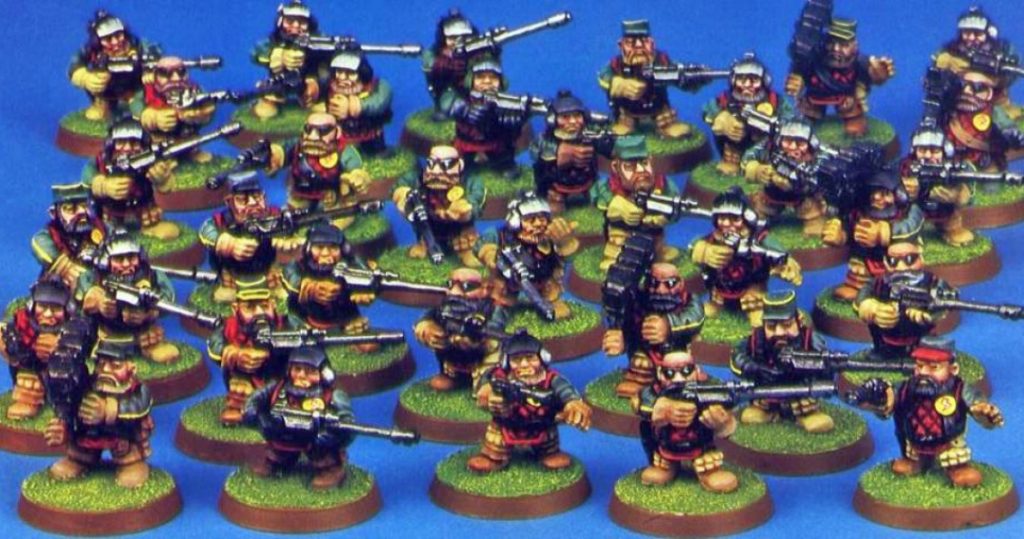
In 2008–almost 15 years before Games Workshop created the Leagues of Votann faction–I decided to make my own “Space Dwarves” army, but I immediately had to answer two questions:
- How to make them look like they belong in 40K?
- What rules to use for them?
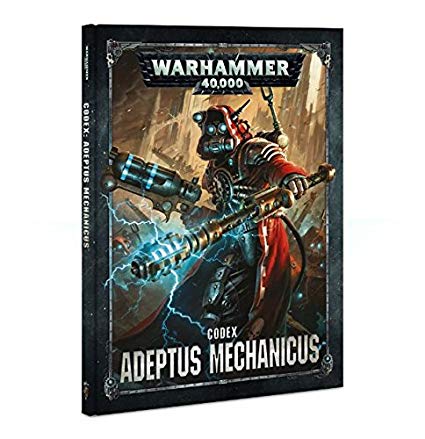
I discuss the answer to the first question in the “Modeling and Painting” section below. For the second question, I used several options over the years. First, I played them as Orks, using that codex. Then (for all of one game), I treated them as a proxied Genestealer Cult, but I found that boring. Then I switched them to use the rules for Adeptus Mechanicus, and did so for a while.
One might think that I would have integrated my army into the Leagues of Votann when they came out during 9e 40K, but by then, I was on my way out the door, abandoning 40K for OnePageRules’ Grimdark Future game, which has the Dwarf Guilds, its version of Space Dwarves. And I’ve used those rules for them ever since.
Modeling and Painting, Part 1: Getting Started
When I first started collecting this army in 2008, I could have gone to e-Bay and found old Squat figures from the late 1980’s and early 1990’s, but I didn’t want to resurrect that old concept with all its baggage: no, I wanted something different.
Originally intended as a proxied Ork army, this force needed a lot of figures. To keep costs down, I went with the very affordable plastic Dwarves from the Warhammer fantasy game, which has since gone through several iterations.
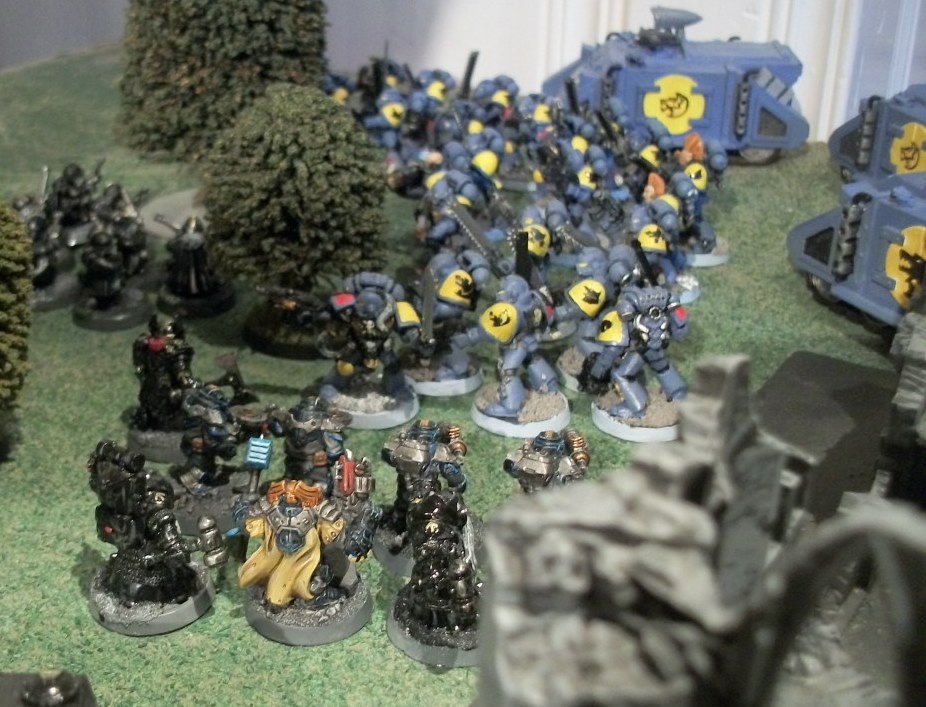
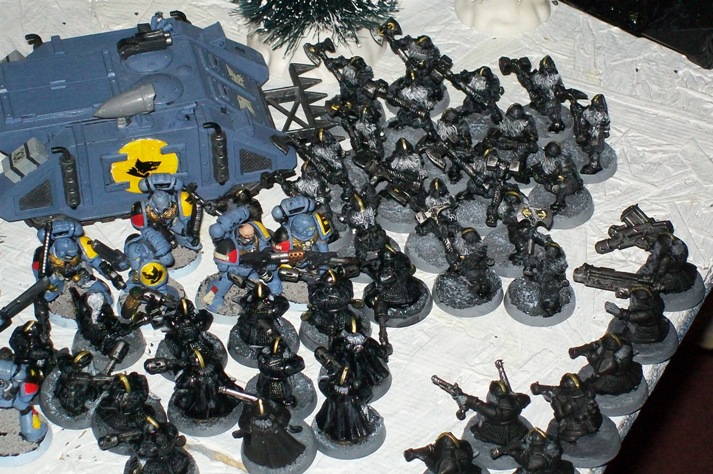
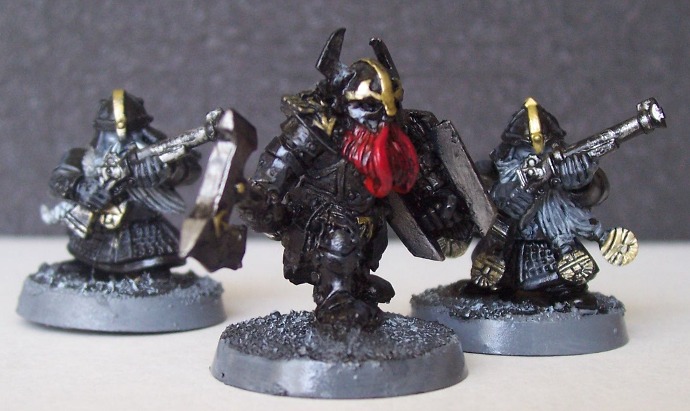
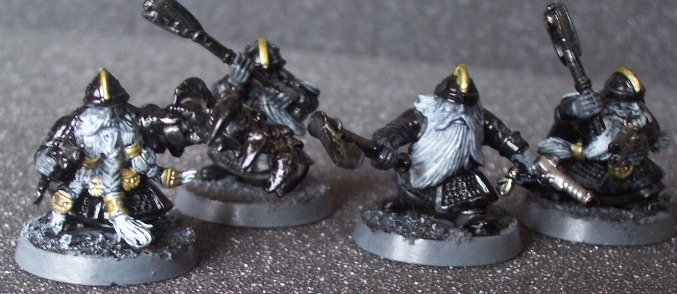
To make my figures look more “40K” and less “fantasy,” I didn’t give them shields; I didn’t use winged or horned helmets; I mounted them on round bases, not the square ones they came with; and I painted their armor in a dark tone, which, at a distance, fools the eye into not noticing that each figure wears chainmail.
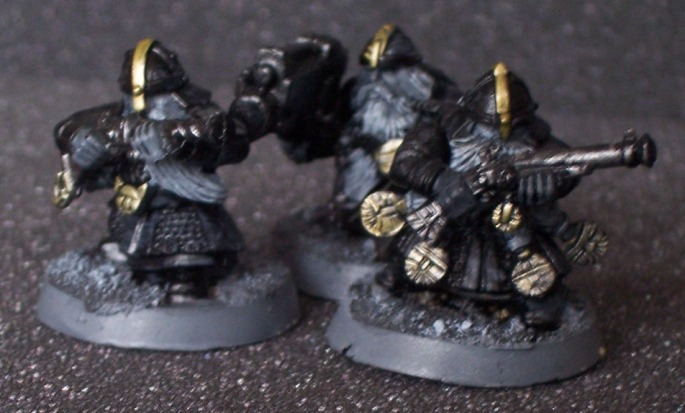
I had a horde to paint, so I kept the scheme very simple and easy to do. I primed the figures black, then went over armor, helmets, clothes, and boots in Chaos Black. Skin was (what was called) Codex Grey (for an alien look), hair and beards were Codex Grey with Skull White drybrushed over them. I also drybrushed Boltgun Metal over weapons and Shining Gold over medallions and other “bling” that each Dwarf figure might have.
In homage to my favorite American football team, the Pittsburgh Steelers, I painted a gold stripe down the middle of each helmet. I “dusted” the black areas with Codex Grey for some highlighting, and washed each figure in thinned-down Chaos Black. Bases were sand flocking, painted Codex Grey with a black wash and highlighted with Space Wolf Grey.
Because I went for quantity and not quality, I didn’t worry about detailing fiddly bits like eyes and belt pouches and such. The painting went very quickly, and I really enjoyed it (which is surprising, because usually I consider painting a chore).
I also added some figures from Reaper Miniatures for leaders and elite units, and I was happy with what I had. “Happy,” that is, until I saw what Mantic Games had done with “Space Dwarves.”
Modeling and Painting, Part 2: Forge Fathers
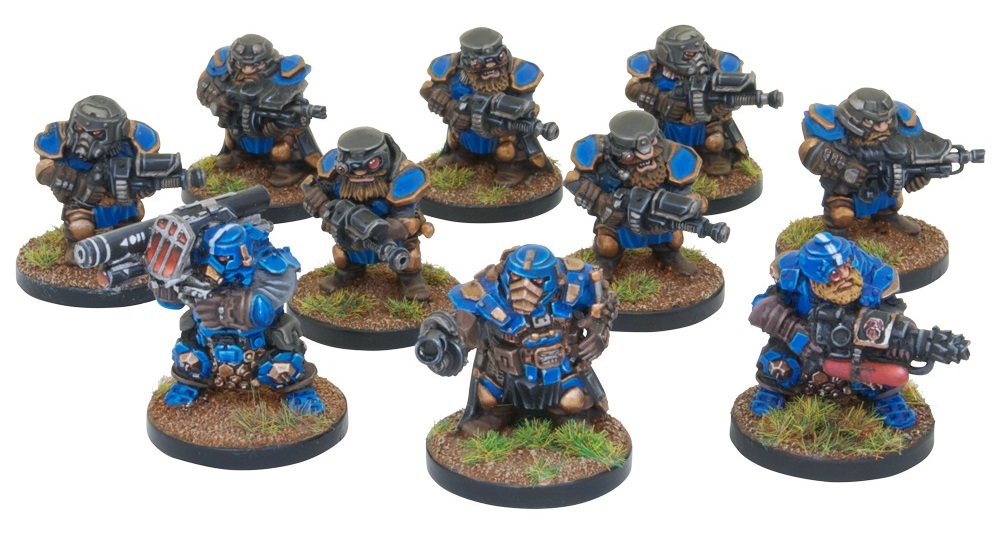
My pal James Arnold painted and gave me some of the Mantic Forge Father figures as a gift. I bought some more, and for a moment, I considered a mad plan to re-do my entire army using models from this line. But while these minis are just wall-to-wall awesome, I simply didn’t have time, so I incorporated them into the rest of my existing army.
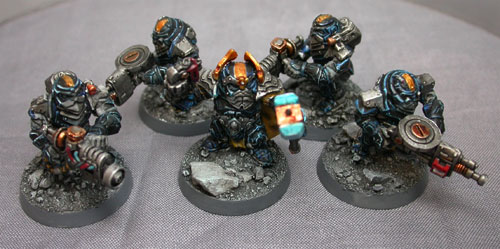
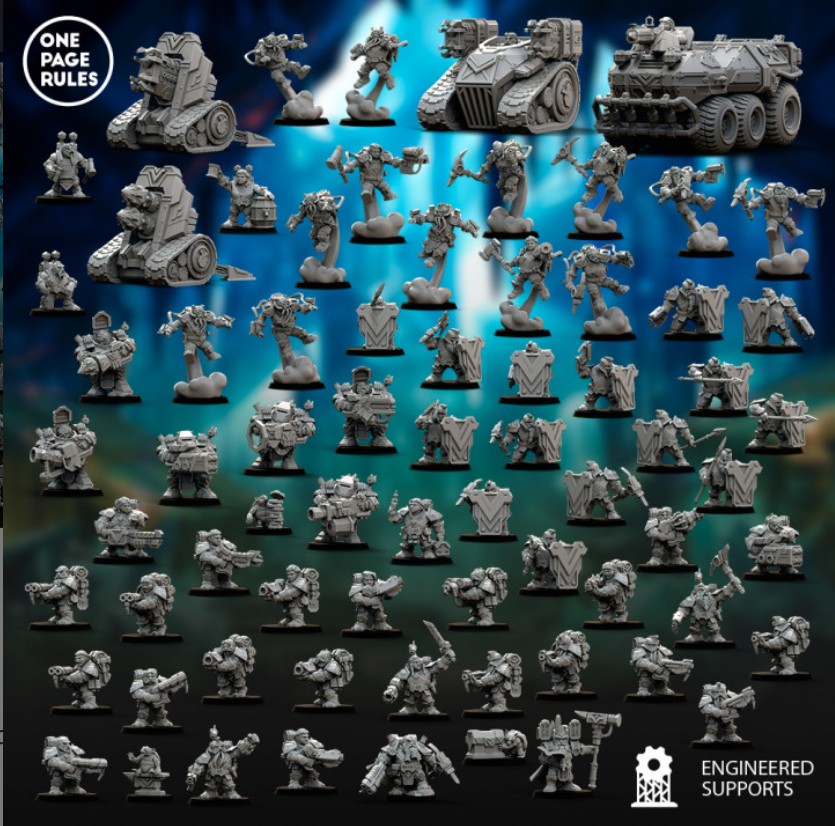
If I were starting over with this army, I would use exclusively Mantic figures and vehicles, but those weren’t available back when I started. Or I would go with OnePageRules’ figures (which are very nice). I could, of course, just use the GW Votann figures, but I want my Space Dwarves to be different from them–more about that in the Background section below.
Modeling and Painting, Part 3: Vehicles
When I originally conceived of the army, I wanted nice, sturdy Battlewagons to get my proxied Orks into the fight. But what to use for models? Ork vehicles look too…well, Orky, and Imperial vehicles look…well, too human.
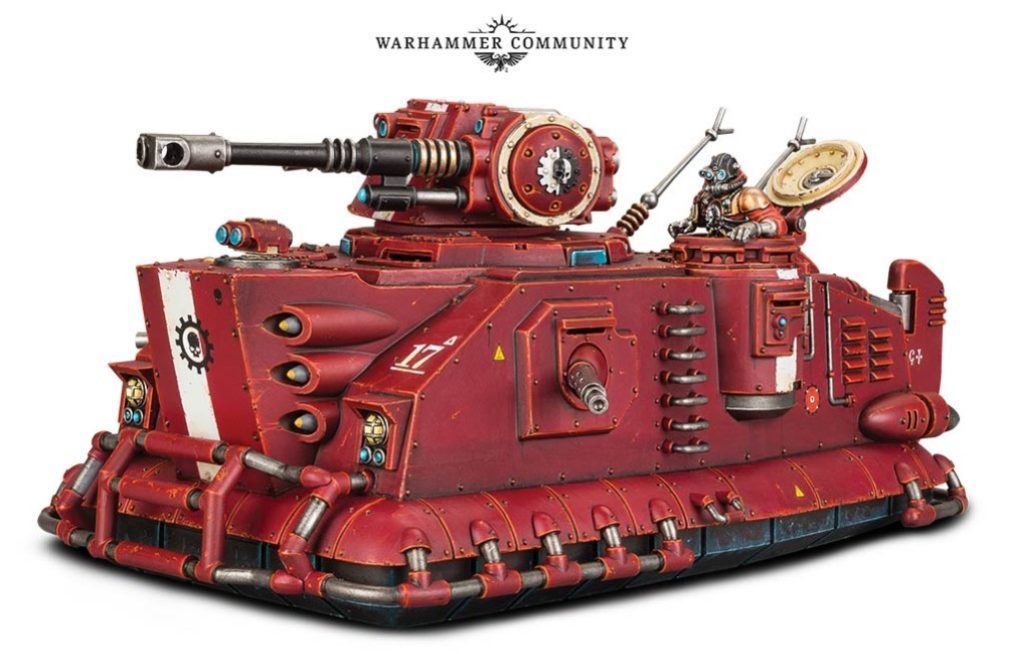
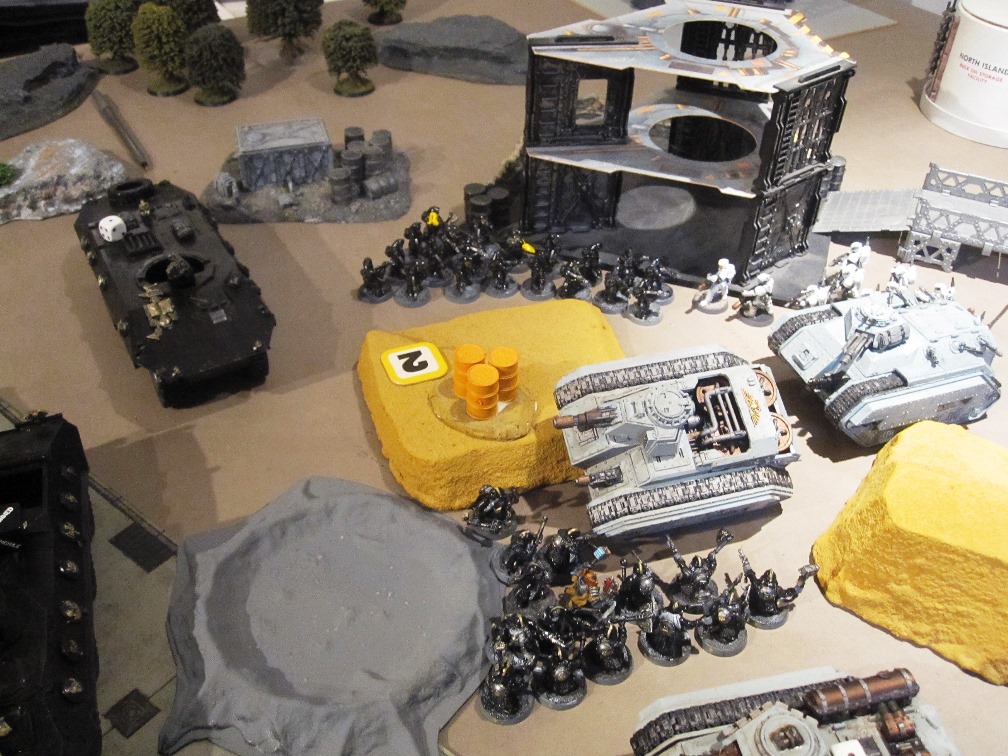
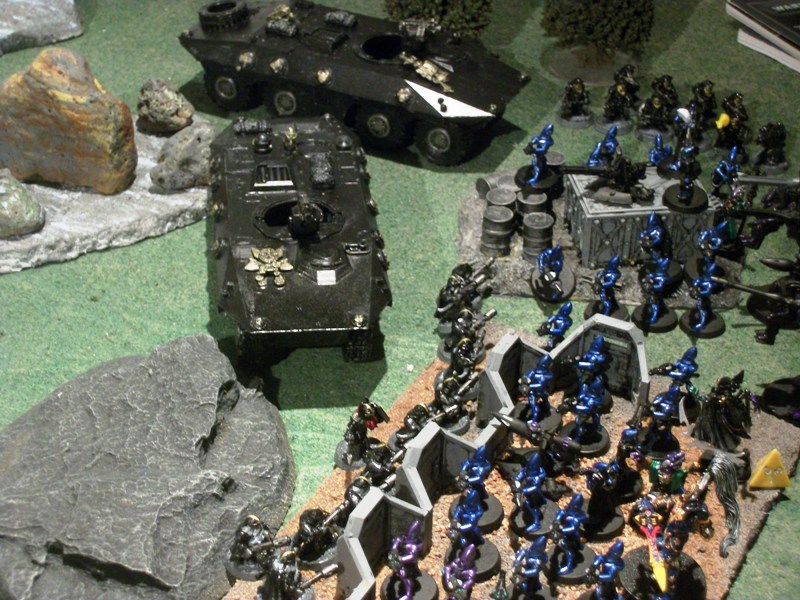
For a Dvergar version of a Battlewagon, I wanted something low to the ground, really tough-looking, and distinct from anything else one might see in the game. After scouring the Internet, I settled on Revell’s 8-wheeled, 1/35 scale SpaePz 2 troop carrier, patterned after real-world tanks used by Germany.
While not nearly as expensive as a GW tank, it wasn’t exactly cheap at $25.50 (+ s/h) online, especially not when I planned to have loads of them in my army. But then, if I wanted to save money, I wouldn’t be wargaming, now would I?
Upon receiving the model kit in the mail, I was alarmed to discover that it was meant for expert modelers intent on building near-exact replicas of real-life vehicles, not gamer schlubs like me looking to slap something together ASAP and put it on the table. The model had all kinds of fiddly bits, and the directions called for about 10 steps just to assemble the vehicle’s axles, suspension system, and wheels.
There was no way I was going to [fornicate] around with all that fussy stuff: I cut all kinds of corners, starting with simply gluing the wheels to the hull of the tank. I very quickly had a stripped-down version assembled.
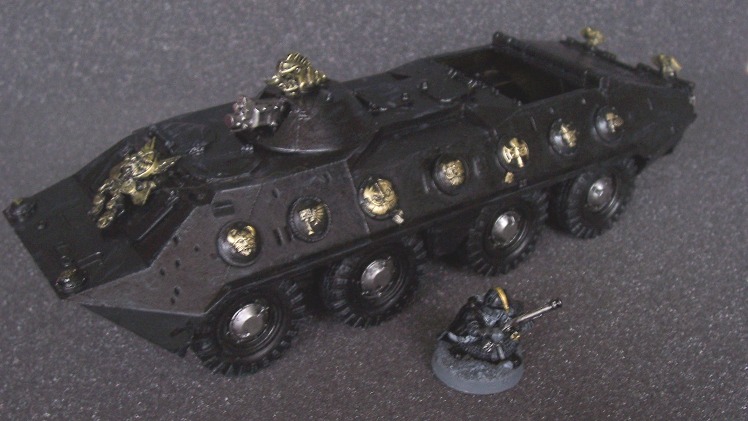
To make the vehicle distinctly Dvergar, and not something that had been liberated from an Imperial Guard motorpool, I added some bits from the many, many Dwarf Thunderer and Warrior sprues I had lying around after I had built some basic guys. I glued them on, painted the tank black, and accented in gold.
Pleased with how the first Crawler turned out, I ordered four more, then found out upon arrival that while they were the same type of model from the same manufacturer, they were nevertheless a different version from the first one.
Each of the four is slightly larger than the original, and, most notably, they do not have the nice open space in the back to serve as a “transport area” for passengers. Each does, however, have a larger turret than the first, so I didn’t put the turret on, leaving a big, round open space up front, which will serve as the “transport area” for riders.
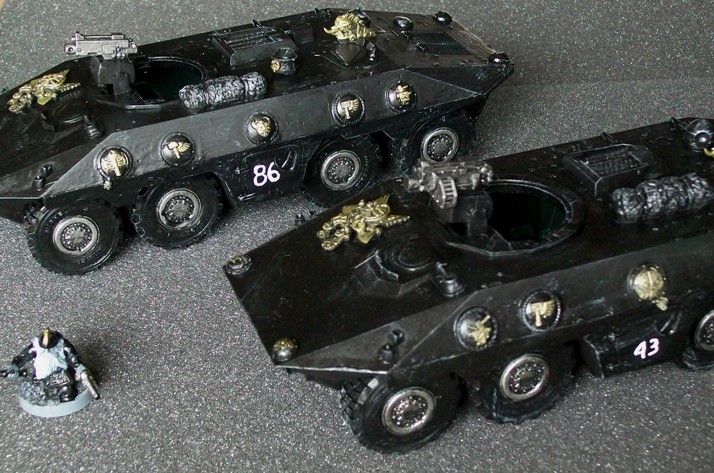
Keeping track of all those Crawlers and which squads are in each could be a hassle, so I painted numbers on them. In another tip of the hat to the Steelers, I made the numbers correspond to my favorite players:
- #7—Ben Roethlisberger
- #36—Jerome Bettis
- #43—Troy Polamalu
- #86—Hines Ward (my wife’s celebrity crush)
- #92—James Harrison (Monster Linebacker From Hell)

As I mentioned, I used to count these vehicles as Battlewagons, but Grimdark Future has the option of creating one’s own units, so I did that. Details in the Waging War section below.
Background
To those who have heard of them, Dvergar are often confused with the Leagues of Votann, but though they look similar, they are not at all related.
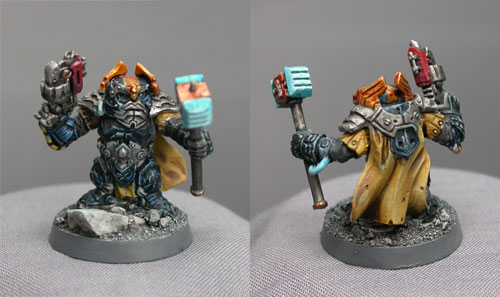
The Dvergar inhabit several large asteroids within the Angrboda Nebula, not far from Fenris, home of the Space Wolves. Dvergar are gray-skinned humanoids, roughly three-quarters the height of the average human, notable for what appears to be white facial hair, usually worn in the same style as a long beard.
Swathed in darkness and bathed in radiation from the surrounding nebula, Dvergar worlds are, at first appearance, lifeless asteroids of rock and ice. In truth, Dvergar clans live beneath the surface in vast cities, mining for metals and minerals, growing fungi for foodstuffs.
Under such harsh conditions, Dvergar society is cruel and pitiless, with no allowance for weakness or mercy. Dvergar have mastered space flight and Warp travel, and constantly send out expeditions to plunder new resources. To the Dvergar, lives, even their own, are worthless: only objects have any value.
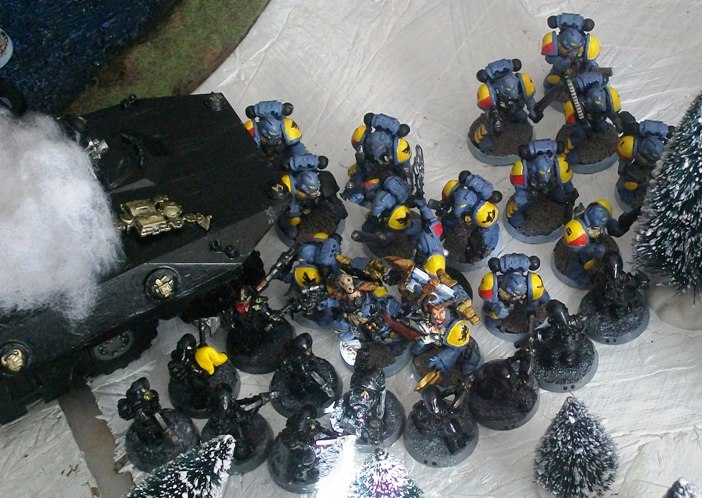
Ancient and bitter foes include the Space Wolves, the Aeldari, and Orks. Chaos has no sway over the Dvergar, for they are followers of Order, albeit a brutal, oppressive one.
Because Dvergar are rumored to amass huge quantities of gold, titanium, and other precious metals, they are often the targets of raids and campaigns by Rogue Traders, Drukhari, and greedy Imperial governors. Such assaults usually end in disaster for the attackers, as Dvergar asteroids are well-fortified, and the Dvergar are masters of close-range fighting.
To the Imperium, the Dvergar are considered a negligible threat, comparable to that posed by other, “lesser” aliens such as the Hrud. While they are technologically advanced, their weaponry is not on par with the awesome firepower of the Aeldari, the T’au, or the Necrons; they are not as numerous as the Orks or Tyranids; nor are they as far-ranging and destructive as the Chaos Marines. This is small comfort, though, to those who find themselves under attack by them.
Waging War
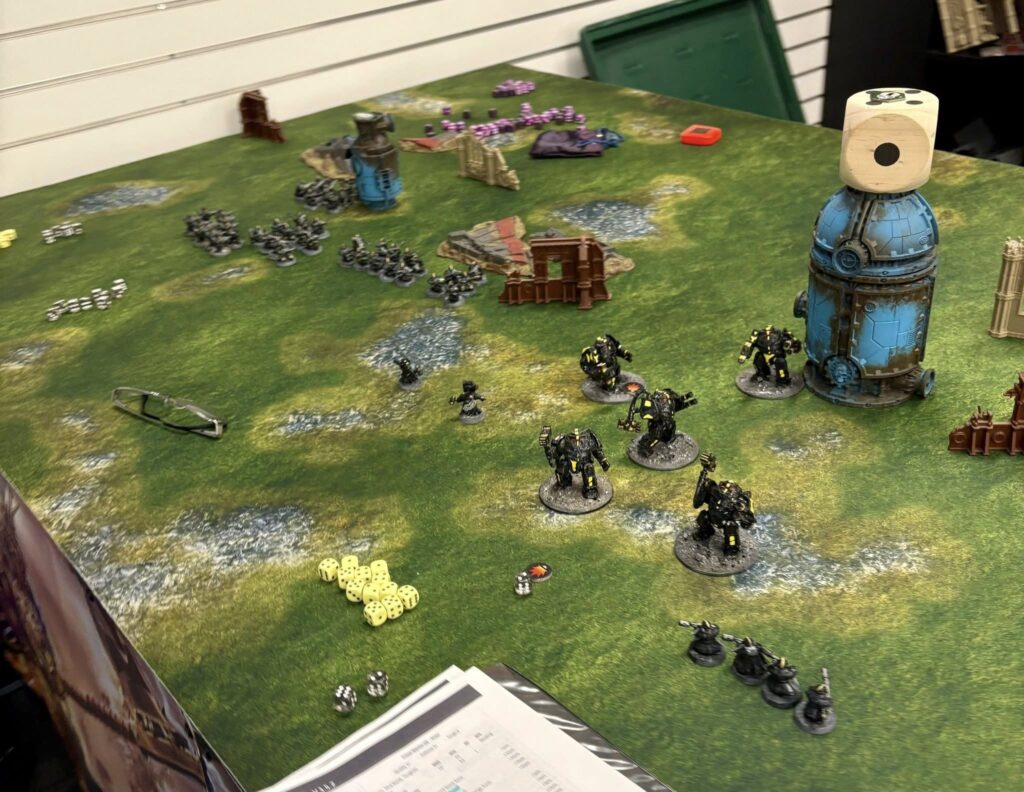
The Dvergar Steeljacks are a horde army that use the Grimdark Future rules for Dwarf Guilds. My army has lots and lots of figures and units, most of them very cheap when it comes to points (see below). In my collection, I have 191 individual infantry, 6 walkers, and 5 tanks. At the time of this writing (April 2026), it all comes to about 7500 points in Grimdark Future, which is probably about 4000 points in 40K (depending on which edition you’re talking about).
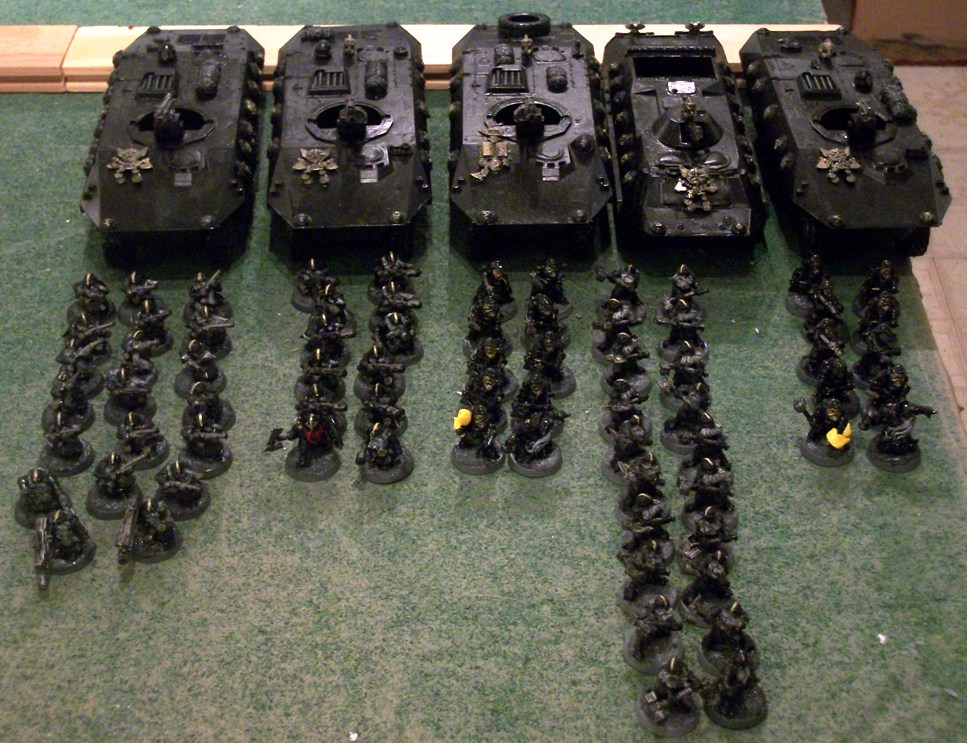
On an individual level, the Dwarf Guilds’ baseline Warrior is average at everything: decent at shooting, decent at fighting in melee, decent armor. He costs 16 points (the equivalent of 8 points in 40K), as compared with 30 points each for your basic Battle Brother, the Grimdark Future version of Firstborn Space Marines (Adeptus Astartes). So, you can get a lot of average guys for not a lot of points.
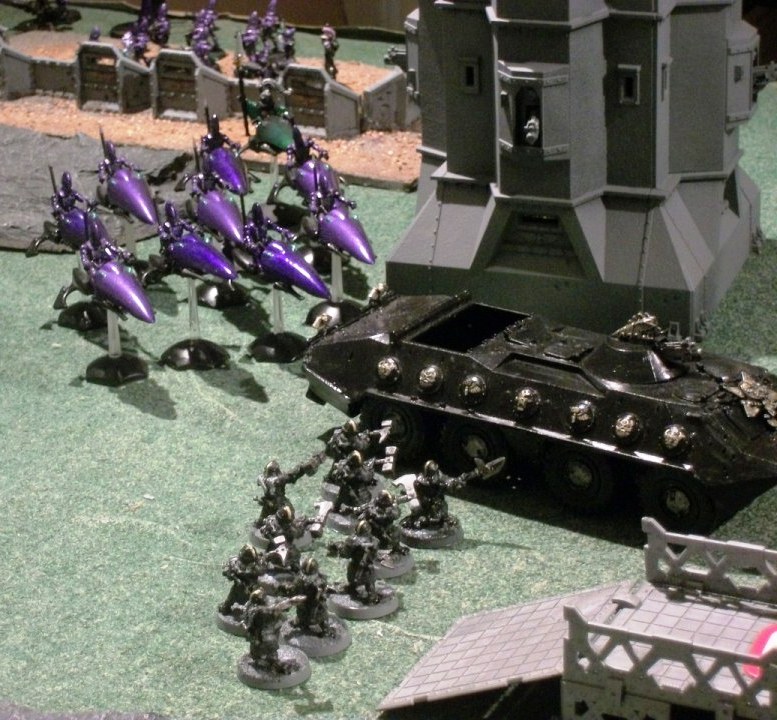
The Dvergar win by attrition, grinding down and wearing out the other guys, even other horde armies like Orks and Tyranids. I’ve often deliberately walked a squad into charge range of Greenskins or Bugs, taken the hits, then shot back or counter-charged with two or sometimes three other squads, wiping out the mob or brood that took the bait.
Because my collection is very large, I’ve split it in two: a “Black” list geared for close combat, and a “Gold” list that emphasizes shooting (the colors are taken from the Pittsburgh Steelers). More about both below.
Black List. The main problem that Dwarf Guilds have in Grimdark Future is that they are slow–literally. Each infantry figure has a rule called “Slow,” which means that each turn (of which there are only four in GF games), they may move 4″ and shoot, or run/charge 8″ (and not shoot). This isn’t so much a big deal for armies that rely on ranged weapons, but for close-combat forces, it’s the kiss of death.
Fortunately, Dwarf Guilds have some speedier options. Units of “Miners” (each of whom can have up to 10 Dwarves armed with close-combat weapons) tunnel under the battlefield, digging their way up anywhere on the board, and appearing 1″ away from enemy units. They then charge right into melee on the same turn. Oh, you thought you would keep all your shooty guys on your back line to maximize the distance between our forces? How cute.
In a similar vein, Dwarf Guilds also have units of Jetpack Warriors, who drop in from the sky. Flying Dwarves–who let me do that? The only real difference between Jetpack Warriors and Miners is that the former have to be placed more than 9″ away from the enemy instead of 1″. You might think that 9″ would be bad, seeing as how Dwarves only charge 8″, but the jetpacks also eliminate the Slow rule. So, my dudes can drop in 9″ away, then charge 12″ (like most other, non-Dwarf units), all, again, on the same turn. Again, who let me do that?
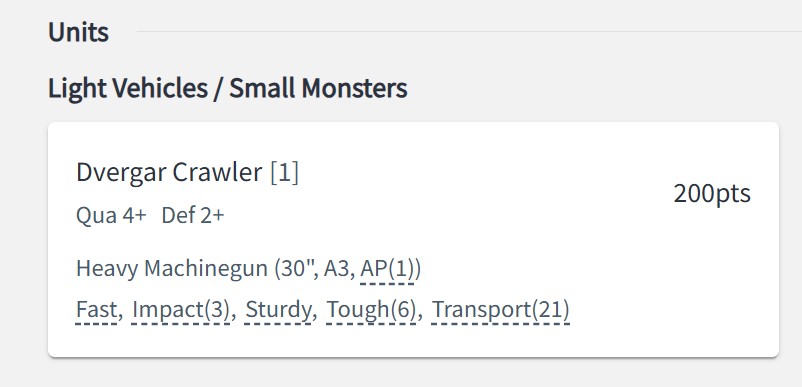
The third option is APCs–armored personnel carriers–which have the Fast rule, meaning that they can move 8″ a turn and shoot, or go 16″ and not shoot. The standard Dwarf Guild APC carries 11 guys and costs 195 points, but OnePageRules has an option to create your own units, so I came up with something a smidge more expensive (200 points) that carries 21 close-combat warriors into the fight.
Gold List. The Dwarf Guilds’ basic rifle doesn’t suck, with 1 shot at 24″ range, hitting on 4+. Again, nothing flashy, but when you can get 10 of these guys for just 160 points (~80 points in 40K)…well, that’s an awful lot of shots per turn.
Accordingly, I have eight squads of baseline Dwarf Warriors with rifles (seven squads with 10 Stunties each, one squad with 5), who tramp forward at 4″ a turn, firing. Five of those eight squads also have one fellow with a “heavy machine gun,” the GF version of a heavy bolter.
Backing those up are four squads of 5 Dwarves each, but instead of the basic rifle, they carry “iron blasters,” a quaint gun with 18″ range and 2 shots per round, with -1 to opponent armor saves.
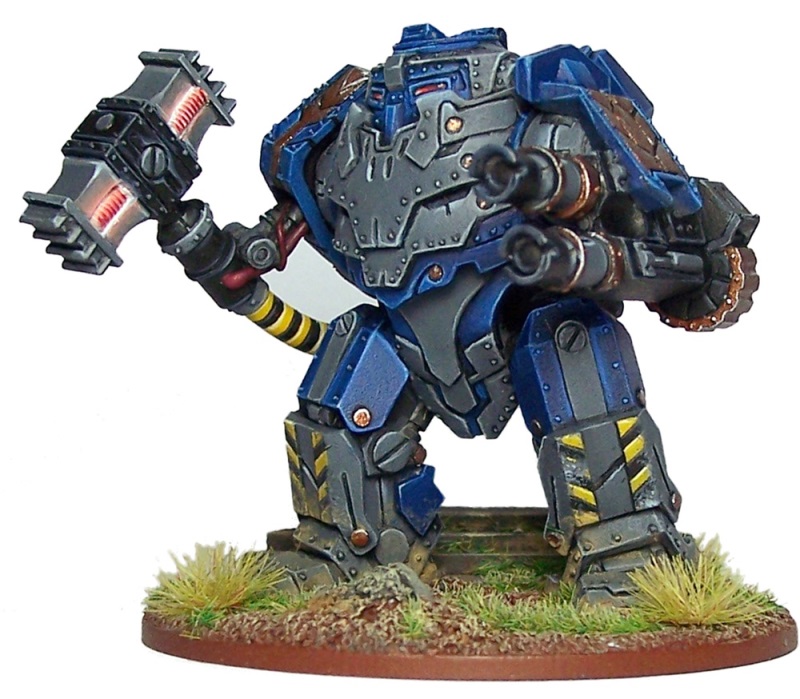
The “big guns” of this list are six Dwarf Walkers, each the equivalent of a Dreadnought. They’re ridiculously tough, and to help keep them upright, I follow them around with Dwarf Engineers who can repair them during the game, restoring Wounds.
Each Walker packs a large, whappy hammer for close-combat goodness; paired with its Stomp attacks, a Walker can kill up to 10 opponents per turn in melee.
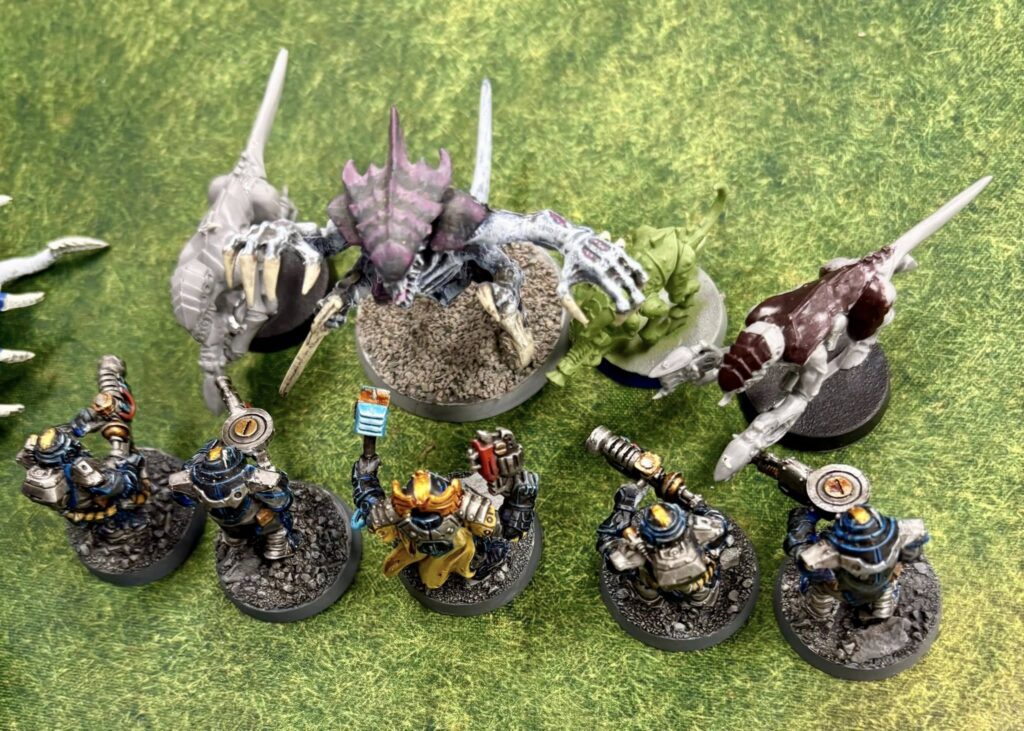
Each Walker also carries a “twin heavy fusion rifle,” the equivalent of a twin-linked multi-melta, perfect for searing very large holes into enemy tanks or monsters. In a recent game, my six Walkers took out the GF version of two Tyranid Bio-Titans (which are very badass hombres) in 3 turns, losing only one Walker.
Conclusion
I’ve played several games with each list, Black and Gold, and have been very happy with the results. Reconfigured and deadlier than ever, the Dvergar continue to terrorize the galaxy—just don’t call them “Squats!”
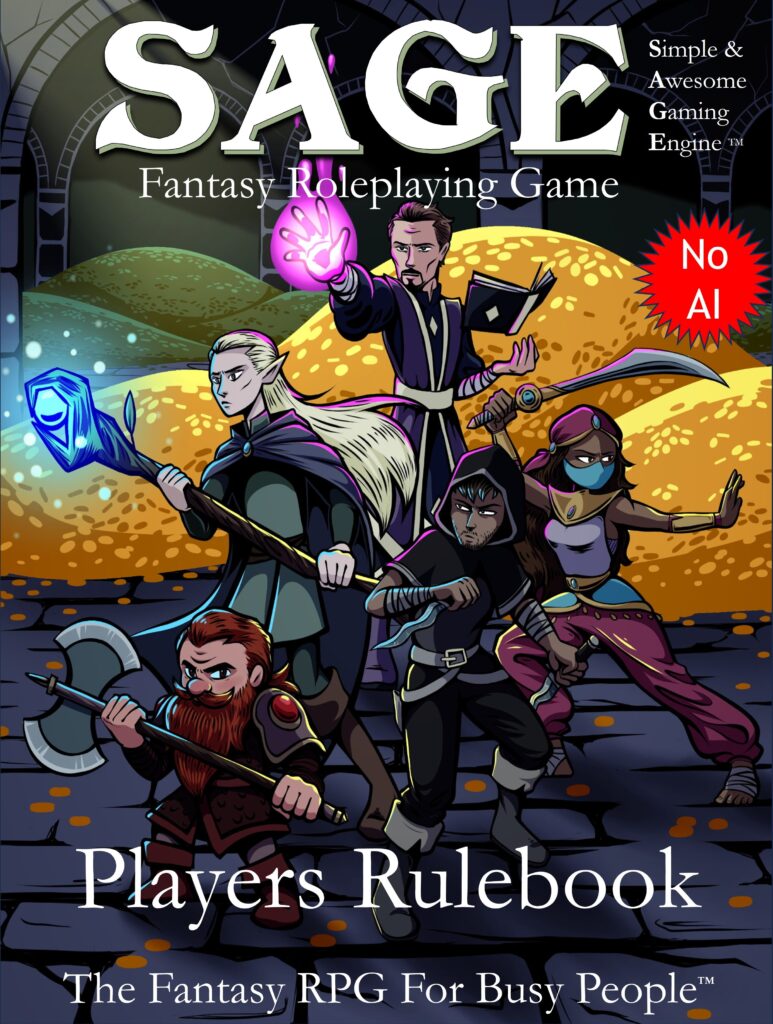
“SAGE” IS COMING! If you love fantasy roleplaying games but hate the clunky rules of old editions, or the bloat and lameness of new editions, you’re going to love SAGE!
SAGE stands for “Simple & Awesome Gaming Engine,” and it’s a fun and easy way to adventure, meant for busy people (new players and veterans) who don’t have the time or inclination to power through 500+ pages of rules spread across multiple books.
SAGE is the game I’ve been wanting to build for the past 30 years, and soon I can share it with you. I have not used any AI when writing or editing SAGE, or for any of its artwork, because AI sucks, and you deserve better.
SAGE is a labor of love designed by gamers for gamers; it’s not a cash grab by a big corporation that only cares about churning out product. Everything the players need will be in one slim, softcover volume. A separate book (about the same size) for the game master will cover monsters, treasure, and magical items. That’s it. Nothing else needed. All reasonably priced, with minimal frills. And, of course, there will be digital versions you can pull up on your phone.
Look for the Players Rulebook early this year, and the Game Master’s Guide in late 2026 or early 2027. You can read more about SAGE here and here and here. Visit www.sagefantasyrpg.com.
Kenton Kilgore writes books for kids, young adults, and adults who are still young. Follow Kenton on Facebook for frequent posts on sci-fi, fantasy, and other speculative fiction. You can also catch him on Instagram.