IN SEPTEMBER 2025, I announced that I am drafting a fantasy roleplaying game called SAGE, which stands for Simple & Awesome Gaming Engine. It’s designed to be: 1) easy to play; and 2) really cool. It’s meant for people who don’t have the time or inclination to plow through 400 pages of dense rules.
The game is very much in the vein of Dungeons & Dragons (D&D), so if you’re familiar with that, you’ll find SAGE very easy to learn (it’s a d20 system). It’s also inspired by Grimdark Future and its response to 40K.
I had meant to debut the Players Rulebook at Awesome Con in Washington DC next month, but I don’t want to rush and put out something that isn’t the best it can be. I still plan on releasing the players book early this year, and the SAGE Sourcebook For GMs: Monsters, Money, & Magic either late in 2026 or March 2027.
The players book is about 2/3 finished. The only big lift remaining is writing up the spells, of which there are quite a few. As in, well over a 100. Hmm. Maybe I’m not as far along as I thought I was.
The Cover
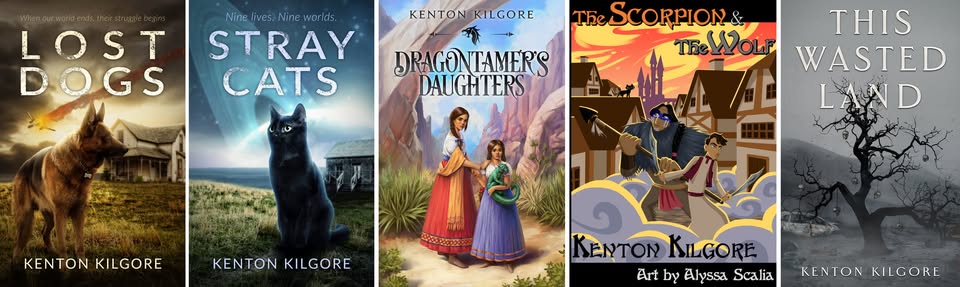
Instead of talking about what’s still on the punch list, let me show you what I’ve completed, shall we? First up is the cover art, done by my long-time collaborator, Alyssa Scalia. She did illustrations for my fantasy novels Stray Cats and The Scorpion & The Wolf (as well as kids’ books about a fraidy cat and a naughty dog), and she’ll be doing the cover for the GM guide, as well.

The fearless heroes on the cover are some of the player characters from the “Silver Age” of my D&D campaign, which wrapped up in Summer 2025 after 5 years. Alyssa did a great job depicting them, and in bringing a fun, exciting vibe to the game. While SAGE is very much inspired by 1st Edition Advanced Dungeons & Dragons, it’s not an “old-school” retro-clone. It takes a lot of the 1e AD&D concepts and makes them easier to play, while letting players do all kinds of cool things.
SAGE will not be AI slop
I hope you spotted the red badge on the cover that says, “No AI.” While some other designers have used AI to write their games and/or produce artwork for it, I will not do so for SAGE. It’s part of my broader refusal to use AI for my books. I wrote every word, and all the artwork is and will be done by actual human beings.
The Rules
So, what are the rules like? As I mentioned in my September 2025 progress report, players have their option of 7 races and 12 classes (4 main, 8 optional subclasses) that will be familiar to anyone who’s played any edition of D&D.
Armor is simplified, and weapon choices are streamlined and bundled together by similar types: if you can use a longsword, you can also use a broadsword, a scimitar, and a short sword just as well. Every weapon does something cool, even the basic, “boring” quarterstaff, which gives its wielder +1 to their Defense Score (aka their Armor Class).

Warriors may specialize in weapons and take Fighting Feats (like those I detailed previously) to be more effective in battle (and to make combat more exciting for players). Rogues and Assassins can focus on certain styles of…errr…“doing business.”
Spellcasters don’t have spell slots: they can cast as many spells as they want to each gaming day, but they have to roll each time to see if their spell works (if they don’t succeed, they can try again in the next Combat Round).
Spells are grouped into “Spheres” based on their nature, not who casts them, so, yeah, you can have a Priest who throws fireballs, or a Wizard who heals.

PCs have a variety of Skills that they can use while adventuring. Some of them (like being able to fight well in total darkness) are geared for combat, some (like Swimming) help keep them alive in certain circumstances, some (like Baking/Cooking) gain the player extra Hero Points.

What are “Hero Points?” During each adventure, players gain them by defeating monsters, acquiring treasure, performing selfless deeds, and doing excellent roleplaying (so, yeah, you actually get rewarded for giving money to orphans, and/or for using a funny voice when your character speaks).
Players can use Hero Points to increase their character’s stats, increase in experience levels, and/or reroll bad dice rolls.

Instead of needing thousands (or tens of thousands) of experience points to increase in level, PCs need 15-25 Hero Points, depending on their class. If a player does well in each gaming session and limits how many Hero Points they spend on stat increases and rerolls, their character can level up fairly quickly.
That’s a feature of the game, not a bug. There’s no point in having abilities, options, and spells for high-level characters if players never get there, because it takes so long to advance that the campaign runs its course.
PCs accumulate treasure, but what do they do with it? One option is funding lavish Lifestyles, which provide bonuses for dealing with NPCs:

Everything–and I mean everything–that a player needs to know is in the Players Rulebook, in one volume of organized, easy-to-read, specific rules, with plenty of examples. I’m drawing on my decades of experience as a professional technical writer to make SAGE a focused, well-crafted, tightly-written rules set that people will actually enjoy reading and referencing.

Play-Testing
My veteran “Silver Age” gaming group is play-testing the rules with me, and at the time of this writing, we’ve done seven sessions. The characters are a good mix of races and classes:
- A Human Crusader (aka Paladin), played by my pal Andy;
- A Human Scout (aka Ranger), played by his son Dylan;
- A Human Witch, played by Dylan’s brother Nate;
- A Gnome Assassin/Wizard, played by our neighbor Steve;
- A Human Warrior, played by my nephew Daniel; and,
- A Half-Elf Druid/Wizard, played by my wife Joni.

The sessions are going very well. The players like that all the rolls–checking for surprise, determining initiative, rolling to hit, casting spells, making saving throws–is a d20 with modifiers. With SAGE providing in-game rewards for roleplaying, the players (particularly Dylan and Nate) have really leaned into it much more than they did before.
Lessons learned have included reducing the number of Hero Points needed to level up (the PCs recently got to 2nd level), clarifying how casters successfully use spells, and tidying up what spells and abilities do.
This group of players forces me to write well-thought out, unambiguous rules, because if there’s a loophole, they will find and exploit it. This is not a bad thing, or meant as a dig against them. Lord knows that Games Workshop would do better if they had more play testers who tried their hardest to bend the rules to the breaking point….
More To Come
I’ll have more about SAGE soon. As mentioned, I’m about to dive into the spells, though, of course, I have already written about a dozen or so that the PCs in my current campaign use. Many spells are similar to what veterans have seen in other games, but some are brand new, and I can’t wait to show you those.

Kenton Kilgore writes books for kids, young adults, and adults who are still young. Follow Kenton on Facebook for frequent posts on sci-fi, fantasy, and other speculative fiction. You can also catch him on Instagram.